
World Cup–ready stadiums are built to perform under changing demands. Flexible structures, adaptable seating, and integrated systems allow venues to meet global requirements without major reconstruction.
Key Takeaways
- Flexibility reduces disruption and cost
- Field and venue systems must perform together
- Crowd behavior shapes design decisions
Overview
A lot of stadiums can host a game. Very few are built to host the world.
The difference shows up quickly. The crowd doesn’t behave the way it does on a typical Sunday. The field requirements change. Broadcast demands intensify. Across the duration of an event like the FIFA World Cup, a venue has to sustain peak performance repeatedly, under changing configurations and operating conditions, and without margin for error.
What we’ve learned is this: World Cup readiness is not something you add to a stadium. It is something you integrate into the design from the outset.
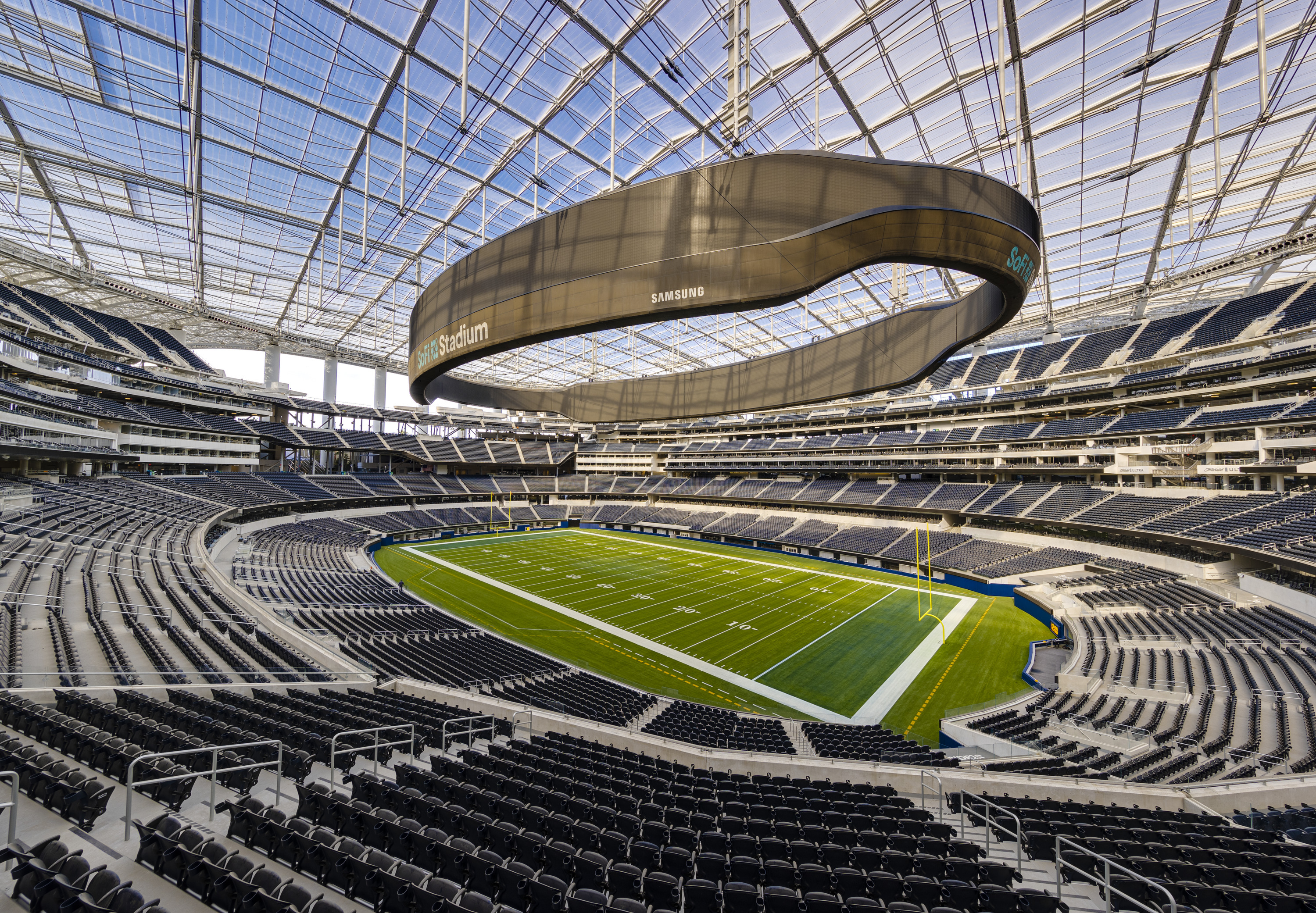
The work required to meet World Cup standards at SoFi Stadium tells a different story than most venues. This was not a wholesale transformation. It was a series of precise, targeted adjustments to a structure that was already built to accommodate large-scale, global events.
Built for It
Before a host city is announced, before tournament requirements are finalized, the most important decisions are already made.
Long-span structural systems, an open and flexible seating bowl, and strategic use of demountable elements create a framework that can evolve. These venues are not designed for a single sport or configuration; they are designed to support variation.
That matters when requirements shift.
Field dimensions and perimeter clearances for World Cup matches differ from NFL contests. Many stadiums face extensive reconstruction to accommodate those changes. At SoFi, the structure allowed those adjustments to happen within the existing framework.
That wasn’t accidental. It was a recognition that venues of this scale need to perform across multiple event types, some of which are not defined at the time of design.
Capacity and Clearance
World Cup play demands more than just a larger field. It requires additional space along the sidelines, corners, and team areas that differs from a typical U.S. stadium football configuration.
Meeting those requirements meant modifying all four corners of the seating bowl:
- Ground-supported demountable seating was removed in key areas
- Concrete rakers were selectively extended to reshape portions of the bowl
- Removable steel framing was added to support alternate seating configurations
Together, these modifications created the field clearances required for international competition while preserving the stadium’s ability to support future events.
That flexibility is the critical piece. Rather than relying on permanent reconstruction, the stadium can adapt to different event requirements through targeted modifications withing the existing structural framework.
It reduces disruption, limits cost and helps preserve the long-term value of the venue.


Designing for a Global Crowd
Many of the same modifications that created FIFA-required field clearances also improved how people move through the venue. These changes were not made solely to create space for the field. They also created more intuitive circulation paths and greater flexibility for managing large international crowds.
World Cup crowds are fundamentally different from a typical home crowd. Fans arrive from different countries, speak different languages, arrive through different transportation modes, and bring their own traditions and match-day routines. Many are experiencing the venue for the first time. That creates unique pressure points in circulation, wayfinding, and areas where visibility and openness matter.
- Seating was reconfigured to improve ground circulation
- Transition zones were expanded to reduce congestion along spectator routes
- Demountable seating systems allow the venue to adapt to different event configurations while maintaining operational flexibility
These are structural decisions, but they are driven by how people behave.
The goal is predictability: clear paths, open views, and fewer conflicts between circulation and seating zones. When the building supports intuitive movement, operational safety improves without relying solely on staffing or temporary measures.

Field Systems
If the structure defines the space, the field defines the performance requirements.
World Cup competition requires a natural or hybrid grass playing surface—something many U.S. stadiums were not originally built to support. The challenge is not just installation, but maintaining consistent performance across a compressed, high-demand schedule.
The solution was a fully integrated field system:
- A natural grass/hybrid surface designed for elite-level play
- A sub-air system to regulate moisture and root-zone conditions
- A new drainage pit to manage water movement and recovery between matches
These systems work together beneath the surface. Airflow, drainage, and temperature control all influence how the field performs—not just on match day, but over the course of the tournament.
These systems are largely invisible to fans, but they play a critical role in tournament operations. Without that integration, surface quality becomes unpredictable over a compressed schedule. With it, the field remains consistent from match to match, even under sustained demand.
The Real Measure
It’s easy to focus on what changed for the World Cup. What matters more is what didn’t.
Meeting global requirements requires targeted modifications, not fundamental reconstruction. That reflects a design approach that anticipates change rather than reacts to it.
Demountable systems, adaptable structure, and integrated field infrastructure allow the venue to meet tournament demands while maintaining long-term flexibility. That is what defines a World Cup–ready stadium: not just one that can host the event, but one that was designed with it in mind.

