
A regional approach to coastal resilience transforms dredged material and surge protection into a multi-benefit system—reducing flood risk while restoring ecosystems, supporting navigation, and creating lasting public value across Galveston Bay.
Key Takeaways
- Coastal flood risk shaped by geography, climate, and development
- Shift from site-specific control to system-wide foresight
- Dredged material repurposed as resilient infrastructure
- Integration of navigation, protection, and restoration goals
- Barrier system designed for performance and everyday function
- Multi-benefit approach: risk reduction, ecology, and access
- Long-term adaptability embedded in infrastructure strategy
Overview
Flooding along the Texas coast is constant threat shaped by geography, climate, and human occupation. Harris County and the broader Galveston Bay region sit within a naturally vulnerable coastal system, where flat terrain, slow‑draining soils, and exposure to tropical storms combine to make storm surge a defining risk. The consequences of that risk are magnified by the concentration of people, infrastructure, and industry along the bay.
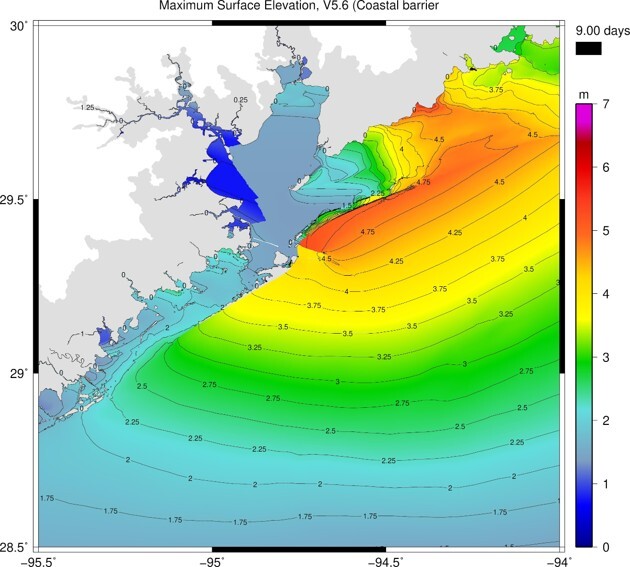
In September 2008, Hurricane Ike made that vulnerability unmistakably clear. While the storm devastated the Texas coast east of Galveston, a small shift in its path could have driven a catastrophic surge into western Galveston Bay. Such an event would have flooded communities, disrupted one of the nation’s busiest ports, damaged energy and petrochemical facilities, and contaminated critical waterways. The near miss galvanized regional leaders, researchers, and engineers to confront a shared reality: major surge events are inevitable, and preparation must extend beyond individual projects.
From Measurement to Foresight
Coastal protection has traditionally focused on controlling water at specific sites. Increasingly, stewardship demands a broader perspective—one that anticipates how water moves across regions and how its impacts cascade through economic, environmental, and social systems.
In response to Hurricane Ike, Rice University’s Severe Storm Prediction, Education, and Evacuation from Disasters (SSPEED) Center, in collaboration with Walter P Moore, began exploring alternatives that could reduce storm‑surge risk across Galveston Bay. We contributed civil and structural engineering expertise to evaluate barrier and gate concepts rooted in both performance and feasibility.
At the same time, plans were advancing to modernize the Houston Ship Channel through Project 12, a federally led navigation effort to deepen and widen the channel to accommodate larger vessels. The project involves significant dredging, producing millions of cubic yards of material as a necessary byproduct of the channel improvements.
Rather than treating this material as waste, the SSPEED Center recognized an opportunity. If repurposed strategically, dredged material could form the backbone of a regional surge‑protection system—transforming an operational requirement into resilient infrastructure.
Turning Necessity into Protection
From this convergence emerged, the Galveston Bay Park concept. The preferred approach envisions an in‑bay barrier system formed by linked earthen embankments and gates that allow circulation, navigation, and ecological exchange under normal conditions, while providing surge protection during extreme events. Bridges over the barrier would support maintenance access and public use.
From its inception, Galveston Bay Park was conceived as more than a defensive structure. By imagining the system as a chain of barrier islands rather than a single wall, the project reframed coastal protection as an asset with everyday value. Our team brought in Rogers Partners Architects to help shape a vision where protection, restoration, and public benefit coexist.


Stewardship at the Regional Scale
The engineering framework integrates multiple objectives into one system:
- Protection: An in‑bay barrier that reduces storm‑surge risk to communities, industries, and ecosystems, while also enabling spill containment within the bay.
- Restoration: Regenerative wetlands, oyster reef mitigation, and managed water circulation to improve water quality and habitat health.
- Resilience: Strategic use of dredged material to reduce disposal impacts, support future maintenance dredging, and create long‑term capacity for adaptation.
- Public Value: Recreation and access features that generate ongoing economic and social returns, helping sustain the system over time.
Every design decision reflects a stewardship mindset: infrastructure meant to operate only in emergencies should also strengthen the environment and community it protects on ordinary days.
Engineering for the Next Surge
Galveston Bay Park demonstrates how engineering decisions can shape outcomes when there is a significant threat. Flooding cannot be prevented outright, but its consequences can be anticipated, mitigated, and managed thoughtfully.
By aligning coastal protection with navigation needs, ecological restoration, and public benefit, this approach moves beyond reaction toward foresight. It reflects a core stewardship principle: water’s behavior is natural, but the impacts we experience are defined by our choices.


