
Green stormwater infrastructure treats stormwater as a resource, accounting for existing hydrologic patterns on a site. Such systems build resilient networks by managing water where it falls with coordinated stewardship strategies.
Key Takeaways
- Green stormwater infrastructure uses nature as a model
- Strategies across locations can act as a coordinated plan
- Stewardship strategies must apply across contexts and scales
Overview
When land is developed, water continues to move across the site, and it remains our responsibility to manage. For decades, conventional development has treated stormwater as something to convey off-site as quickly as possible. Green Stormwater Infrastructure (GSI) offers a different response, one rooted in the stewardship of a resource rather than the removal of a burden.
The built environment often creates stormwater challenges, including degraded water quality and added strain on downstream systems, impacts that are increasingly intensified by extreme weather. Engineers must account for how stormwater is captured, treated, and released from a site. In practice, that can mean slowing runoff, filtering pollutants, encouraging infiltration, and restoring functions that development has displaced.
Working With Water
A stewardship approach to stormwater management begins with understanding how water naturally moves through a site. The most effective solutions bring developed land into closer alignment with previous hydrologic patterns by restoring storage, filtration, and flow paths the land once provided on its own.
GSI helps achieve this by adapting elements already in the design and embedding those functions throughout a site, encouraging a more holistic response than simply meeting minimum requirements. GSI enhances traditional design elements to embed ecosystem services throughout a site. Instead of relying solely on centralized detention or conveyance, this approach uses small but intentional adjustments to turn features such as landscaping, pavement, and circulation areas into tools for managing water.
By refining these elements, engineers can create bioswales, bioretention areas, and permeable pavements that are distributed throughout the site and function as layered systems. Individually, each feature treats a portion of runoff; together, they form resilient networks capable of responding to a range of conditions.
Just as importantly, GSI does not reinvent how water behaves. Nature already provides effective models. GSI succeeds when it follows the land and mimics predevelopment patterns, restoring storage where low areas were filled, filtering runoff where pavement replaced green space, and slowing flow before it concentrates downstream.
GSI in Action
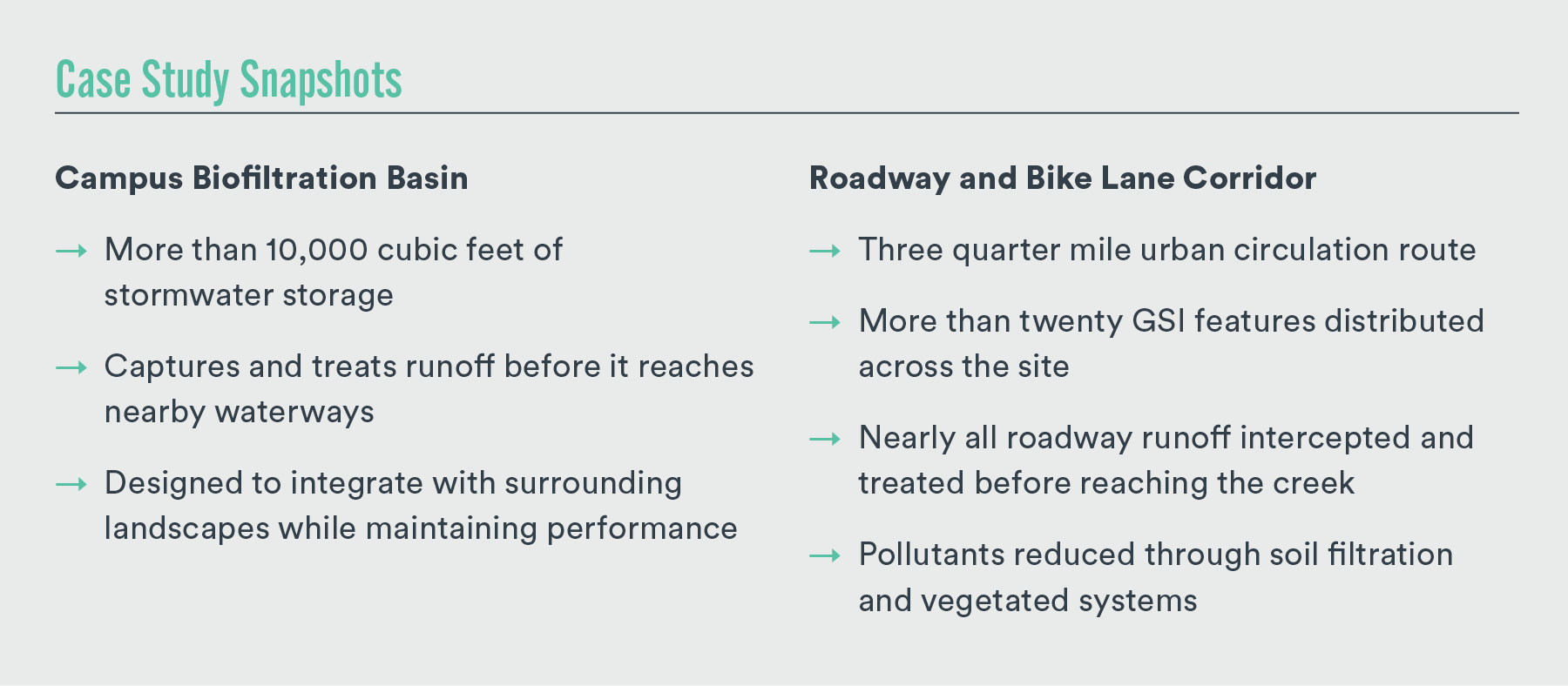
Across The University of Texas at Austin, a major urban campus, our teams implemented GSI through multiple, complementary interventions, demonstrating how stewardship scales from localized features to coordinated, campus wide strategies.
One of the most illustrative examples is the re alignment of a three-quarter-mile roadway and bike lane corridor that serves as a primary circulation route through campus. While essential for daily movement, this corridor previously discharged runoff directly to a nearby creek, carrying oils, sediments, and debris with every storm. The reconstruction of this essential corridor provided an opportunity to filter out these substances from runoff before it is discharged to a nearby creek.
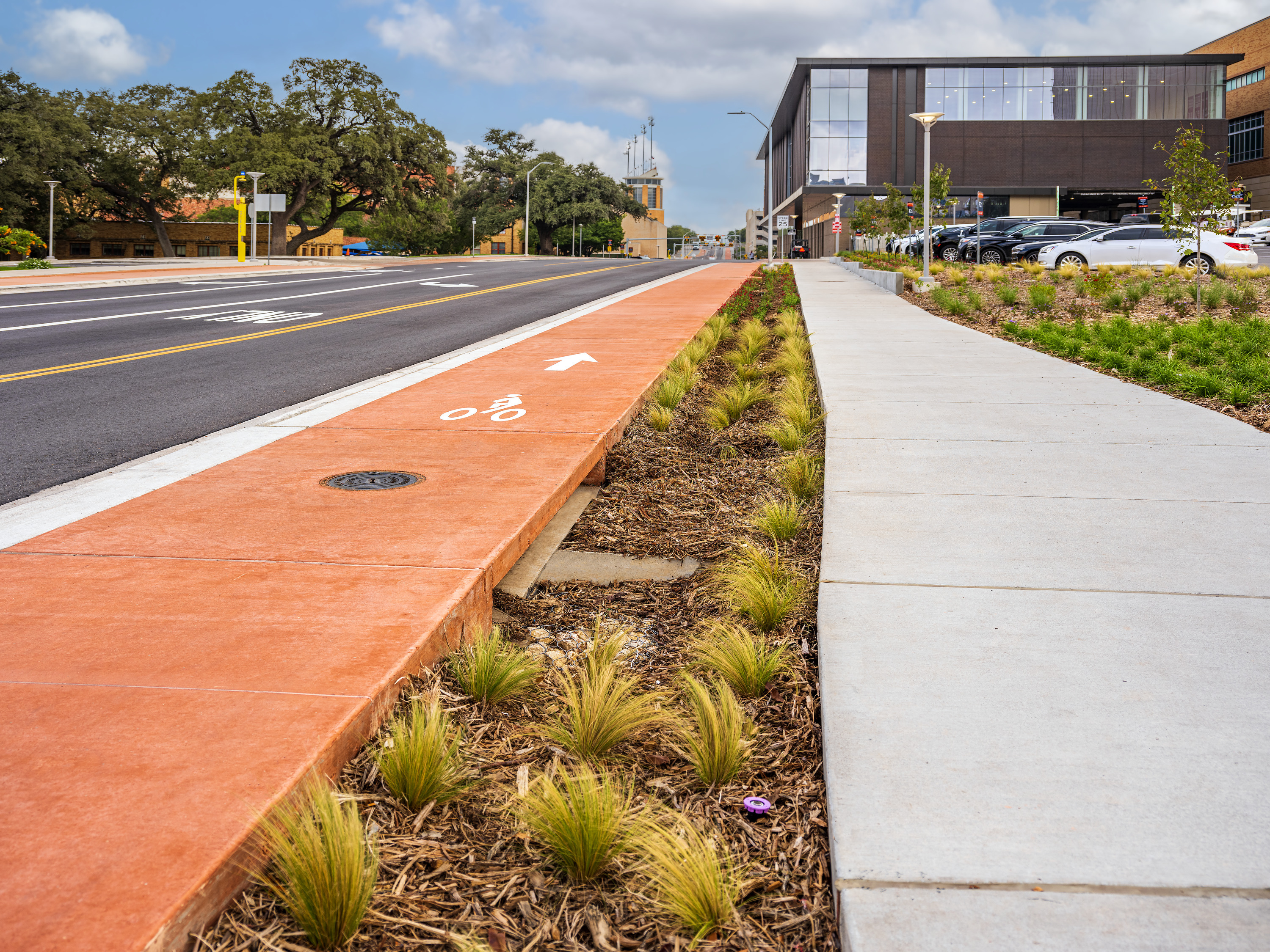
Rather than concentrating treatment in a single location, the design distributes GSI features along the corridor. Bioswales, rain gardens, and permeable areas intercept runoff at the source, slowing flows and filtering water through soil and plant root systems before it is released gradually. By treating the water where it falls, the system improves water quality while reducing downstream demands.


A Scalable Strategy
As development continues and storm events grow more intense; the importance of thoughtful water stewardship becomes clearer. The consequences we experience tomorrow are shaped by the engineering decisions made at the site level today.
Stewarding water begins with incremental, intentional choices that improve how a site manages water and help restore balance between development and natural systems. GSI solutions are versatile and can be embedded into developments of any size, from small parking lots to master-planned communities, creating meaningful impacts, one decision at a time.
Paired with other water management strategies, green stormwater infrastructure is an important tool to address complex challenges at larger scales—and even a single, thoughtfully integrated feature can make a world of difference for the next drop of water.


