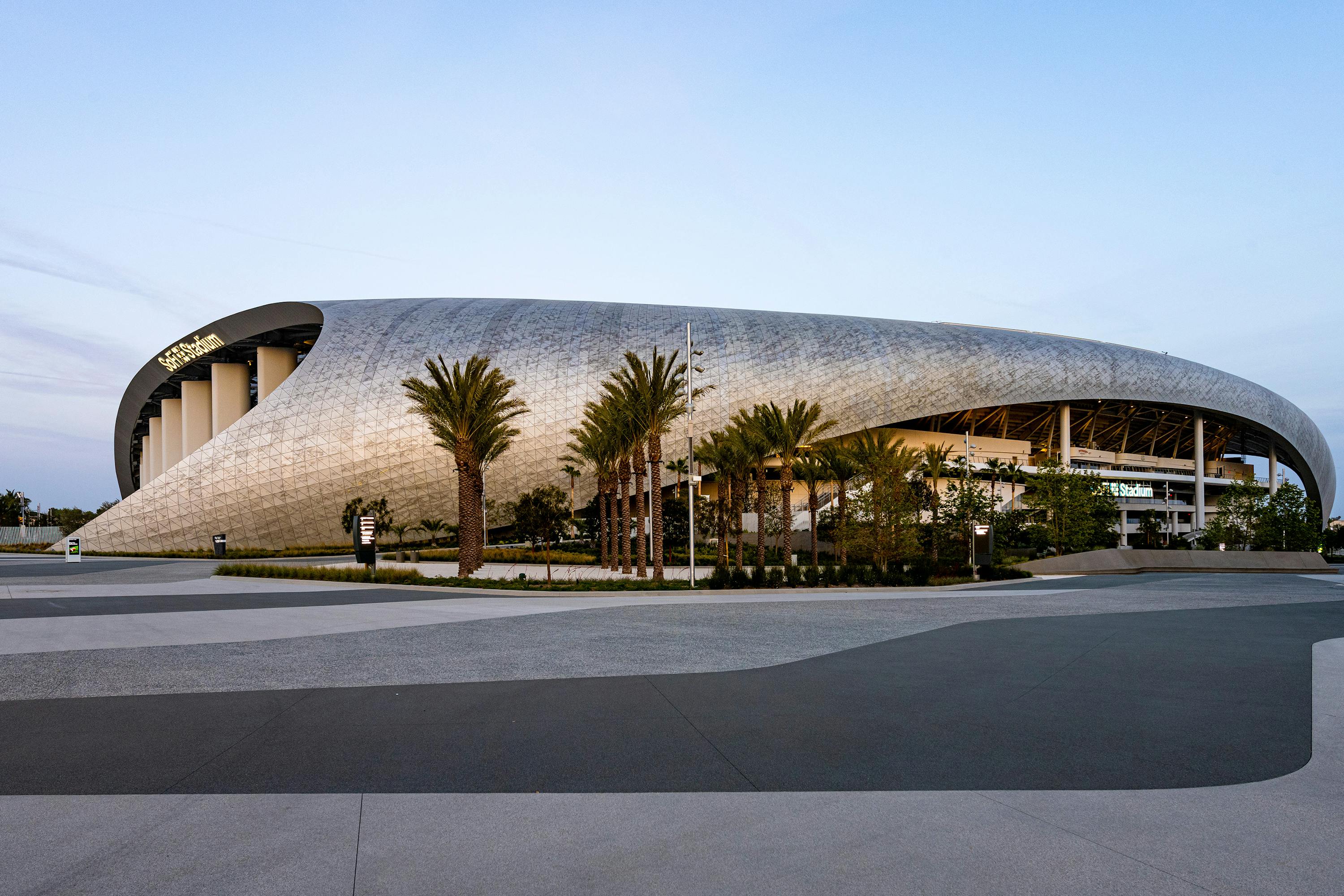
SoFi Stadium
A shining example of engineering excellence gives fans the feeling of being outside
Project Facts
| Location | Inglewood, California |
| Owner | E. Stanley Kroenke |
| Size | 3,100,000 SF |
| Status | Completed 2020 |
| Capacity | 70,000 seats |
| Certifications | Pursuing LEED |
Overview
Walter P Moore provided enclosure, construction, parking, and structural engineering services for SoFi Stadium, a 3.1 million-square-foot, indoor-outdoor venue that serves as the home of the Los Angeles Chargers and the Los Angeles Rams. Located just 500 yards from an active earthquake fault, the project’s swooping roof shades three seismically independent structural systems while also adhering to local height requirements due its position along an active flight path. Armed with several industry-first structural features, SoFi Stadium demonstrates engineering excellence under complex site conditions.
Services
70
K
Seating Capacity
2.2
Million
Weight of video board in pounds
1
st
Micro-operable roof panels in sports industry
27
K
LED pucks on stadium roof canopy
100
%
Of aluminum canopy panels are recyclable


Challenges
Seismic Requirements
SoFi Stadium is located just 500 yards away from the active Newport-Inglewood fault line, which created significant seismic challenges that the engineers needed to resolve.
Height Requirements
The site was just three miles away from Los Angeles International Airport, and the structure had to comply with height restrictions since it was below two flight approach paths.
Bowl Structure
The design of the stadium seating bowl needed to account for thermal loads and dynamic seismic loading without large seismic joints, to maintain uninterrupted concourses on the upper levels, permitting clear sightlines and smooth patron movement.
Roof Design
The curved roof shell had to be optimized for fabrication and assembly while also serving multiple functions, from shading the structure’s three venues, to supporting the distinctive suspended videoboard.

Solutions
Seismic Decoupling
We conducted a geotechnical analysis of soil behavior and soil-structure interaction (SSI) analysis to create three decoupled structural systems comprising a mechanically stabilized earth wall (MSE), triple pendulum roof dampers, and the stadium bowl, to deal with seismic loads independently.
Sunken Bowl
To adhere to height requirements, we sunk the seating bowl 100 feet below ground level and used a 260,000-square-foot MSE wall of the same height to separate the structure from the surrounding soil.
Design Innovation
Walter P Moore used a combination of buckling resistant braces (BRBs) and lockup devices (LUDs) to manage seismic and thermal loads in the seating bowl without large joints or any interruptions in sightlines and concourse functions.
Hybrid Structure
We devised a roof assembly consisting of a massive cablenet structure and ETFE panels broken down into 60 square foot “picture frame” sections to optimize passive ventilation strategies along with fabrication and erection methods. A lightweight long-span cable net structure was also used to suspend the videoboard.


Results
Resilience
SoFi Stadium’s symphony of independent structural systems exhibits consistent and reliable performance, demonstrating engineering excellence that can keep patrons safe in virtually any seismic event.
Structural Independence
The MSE wall allows the seating bowl, which is among the NFL’s largest, to move laterally during seismic events, independent from embedded below grade structures like plinths for the main roof columns and tie beams connecting independent foundations.
Design Efficiency
The hybrid structure of over 1000 BRBs and 48 LUDs contributed to the seating bowl’s optimized seismic performance and eliminated potential costs from seismic joint maintenance.
Indoor-Outdoor Experience
With an area of 1.2 million feet, the stadium’s freeform roof is the world’s largest cablenet structure, designed to minimize embodied energy and equipped with computer synchronized operable roof panels that produce a true indoor-outdoor experience.

Project Team Leaders


